Q&A: Caroline Lea, Author of ‘Love, Sex & Frankenstein’
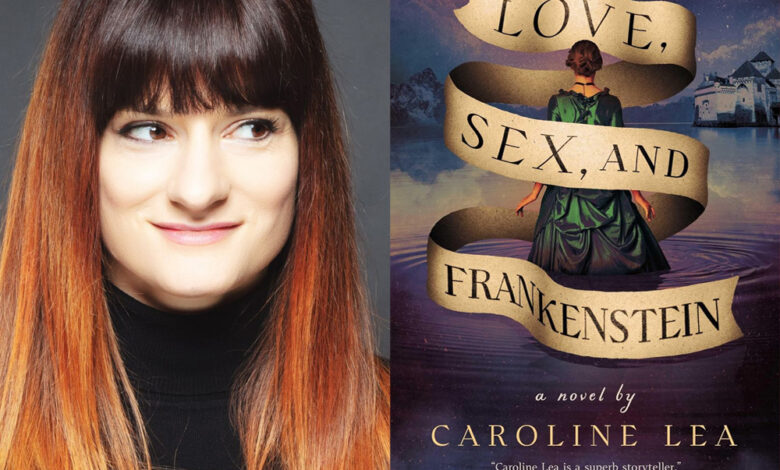
We chat with author Caroline Lea about Love, Sex & Frankenstein, which is an evocative, haunting retelling of the summer that should have broken Mary Shelley, but instead inspired her to write her masterpiece.
Hi, Caroline! Can you tell our readers a bit about yourself?
Hi to you and your readers!! I’m a writer, writing teacher and book obsessive. I write historical fiction about ordinary women who, through extraordinary circumstances, find the strength to change and grow. I’m a mother of two teenagers, a baking enthusiast, a science and psychology nerd and a recovering perfectionist.
When did you first discover your love for writing and stories?
I’ve always been an obsessive reader. As a kid, I read everything – milk cartons, cereal boxes, the inappropriate books about a talking penis that my parents kept in the bathroom… I wish I was joking.
One of my earliest memories is stapling together the story I’d written about a dinosaur that befriended a child and then gatecrashed their school day, destroying the building, the teachers, the bullies. One entire page of the story was the dinosaur saying, ‘Hahahahahaha!’
So I suppose I’m saying that books, for me, have always been an escape and a way of exploring what the world could be.
Quick lightning round! Tell us:
- The first book you ever remember reading: Danny and the Dinosaur, by Sid Hoff (presumably, this inspired my debut dinosaur novella)
- The one that made you want to become an author: The Pendragon Cycle, by Stephen Lawhead. The first three books are a wonderful reframing / mashup of lost Atlantis, Welsh folklore and Arthurian legend.
- The one that you can’t stop thinking about: The God of Small Things, by Arundhati Roy. Mind-bogglingly brilliant and beautiful and devastating.
Your latest novel, Love, Sex & Frankenstein, is out now! If you could only describe it in five words, what would they be?
Furious, fraught, sexy, monstery, and inebriated
What can readers expect?
Mary Godwin, aged eighteen, has fled London with her lover Percy Shelley and her stepsister Claire Clairmont. Seeking relief from the debts and gossip and grudges that have haunted them in London, the group go to Geneva to meet Lord Byron, the notorious celebrity poet. Mary envisages a summer spent reading and walking by the lake. But this is 1816, the year without summer, and savage storms confine them to the house Byron has rented. There, Mary discovers that the past pain she has tried to bury has followed her, along with fury at her lover who keeps rejecting her and the turmoil of her growing attraction to Byron. When Byron challenges everyone to write a ghost story, Mary’s truth spills from her in thick, black ink and the rage she feels threatens to overwhelm her. Readers can expect passion, female rage, a creative woman finding her voice…as well as love, and sex and, well, Frankenstein.
Where did the inspiration for Love, Sex & Frankenstein come from?
So yes, the novel is about how Mary Shelley came to write Frankenstein, but it’s really about a young and vulnerable woman finding her voice and embracing her inner rage. Isn’t that what we all want to learn to do? I’d love to be able to feel fury without shame, and I’ve given Mary that gift in the book. It’s an exploration of the forces and relationships and turmoil that formed the writer she became and the incredible story she wrote. She was only eighteen when she wrote the novel but she’d had such a full and chaotic life up until that point, shaped by death and tragedy in her younger years and then, when she was sixteen reshaped by her love affair with Percy Shelley and her decision to elope with him. All this past trauma, along with her fraught relationship with her stepsister and her pain at losing her mother forms the backdrop to the passionate, painful story of a young woman who creates one of the most iconic figures in literature. Since it was first published, over 200 years ago, Frankenstein has never been out of print. How did a young woman with no formal education create such a terrifying monster? It was a wonderful inspiration for a novel.
Were there any moments or characters you really enjoyed writing or exploring?
Oh, so many! I loved writing Byron – he’s so repellent in so many ways, but I enjoyed exploring his vulnerability as well as his darkness. I frequently wanted to murder Shelley! The fraught and complex relationship between Mary and Claire was so interesting to write. Ultimately, the most joy came from discovering Mary as a character. Ridiculous as this will sound, I feel like I now know the real Mary Shelley: her fears and anxieties and fury felt more and more relatable as I wrote. One of the things I love about historical fiction is that, although the time period and context might change, the fundamental drives and emotions that underpin the characters remain. Mary lived and breathed and wrote 200 years ago, but I hope readers today will find parts of themselves in her.
Did you face any challenges whilst writing? How did you overcome them?
It’s difficult to write about real people when so much is known about them already. There are lots of brilliant non fiction books about Mary, Byron and Shelley in particular. I had to decide, very early on, to allow myself the freedom to fictionalise parts of Mary’s world – both external and internal – in order to create the best story. It was a struggle, initially, to push past the scholarly versions of the historical figures and to allow them to breathe on the page and have autonomy and flaws, as fictional characters need to. The flaws were less of a problem with Shelley and Byron but it was very difficult to get under Mary’s skin and stop her from being too ‘good’, particularly as I felt such compassion for her. The solution, as always, is redrafting and rewriting. It’s not glamorous or fun, but sometimes, you just have to rip out a page (a chapter, an entire novel) and start again. I rewrote this novel in its entirety twice, from scratch, and redrafted countless times, over many months. It wasn’t pretty but it was worth it. Mary is alive for me now and, I hope, she lives for the reader too.
What’s next for you?
I’ve written a speculative novel called The Thousand Deaths of Romeo and Juliet, which has the famous characters stuck in a time loop across history. I love it! It’ll be published in 2027 in the UK, US and various other territories – under the pseudonym Caroline Finch, so my readers can distinguish my speculative writing from my historical novels.
Lastly, what books have you enjoyed reading this year? Are there any you’re looking forward to picking up?
Oh, I’ve loved Bury Our Bones in the Midnight Soil by V.E. Schwab, Atmosphere by Taylor Jenkins Reid, Fundamentally, by Nussaibah Younis and Mother Mary Comes to Me, by Arundhati Roy.
I’ve also just finished The Secret Lives of Murderer’s Wives by Elizabeth Arnott, which will be out in April 2026 and is brilliant. And I’m really looking forward to reading Katabasis, by R.F. Kuang.
This will not be news to your readers, but books are the best. If any of your readers would like to give me their own recommendations, via Instagram or X, I’d love to hear them.
Will you be picking up Love, Sex & Frankenstein? Tell us in the comments below!
Source link