
5 Books that Helped Me Write What About the Bodies With Ken Jaworowski
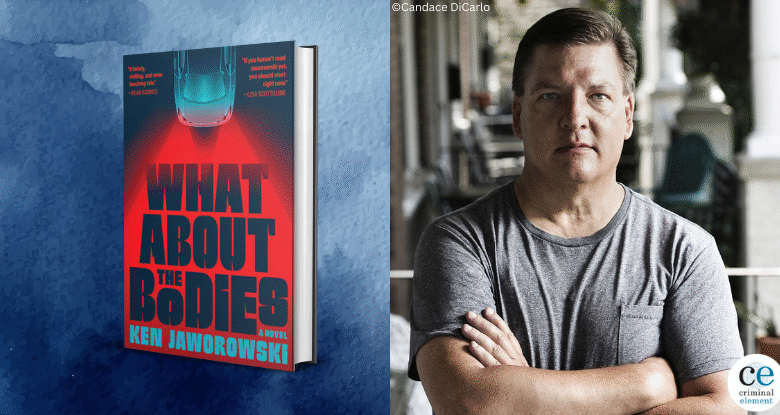
In this propulsive crime novel from Edgar Award nominee Ken Jaworowski, three lives collide in a gritty rust-belt town—a single mother covering up a deadly mistake, a young man on a mission to honor a dying wish, and a musician racing to escape a violent debt. Keep reading for an essay from Ken about the books that helped him write What About the Bodies
In my new thriller, What About the Bodies, three characters get caught up in crimes in a small town. Carla, a single mother, finds herself transporting one of those titular bodies in the trunk of her car, while Reed, an autistic young man, sets out to keep a promise that could get him jailed. At the same time, Liz, a struggling musician, gets mired in a mess involving a brutal ex-con. There’s a bit of blood, a lot of action, and, I hope, a couple of laughs.
I wanted all of the characters to ring true. But I felt a special obligation to get Reed right, and I read several books to help me.
Autistic characters have become quite prevalent, particularly in detective fiction. But just because they’re there doesn’t mean they’re accurately depicted. Autism, described as “a broad range of conditions characterized by challenges with social skills, repetitive behaviors, speech and nonverbal communication” by the advocacy group Autism Speaks, brings with it impairments that can vary from mild awkwardness to sensory overloads to self-harm.
Yet the disorder is often employed by lazy writers who want to introduce an oh-so-quirky character with easy-to-overcome setbacks. Worse still are those who treat autism as some kind of mysterious superpower, while at the same time disregarding its frustrations.
I won’t tell anyone how to write, and would never demand strict realism or reject smart humor. But understanding non-neurotypical persons in both their merits and their messiness can lead to better insights into all people, and to richer stories and characters.
Arguments over such characters will arise: Was Sherlock Holmes, who is described as aloof, and who possesses an intense focus and an ability to recall endless details, on the spectrum? Lisbeth Salander? Boo Radley? Stevens the butler in The Remains of the Day? I can’t say, but I do know all were well-rendered.
I worked hard when writing about Reed in What About the Bodies. Here are five excellent books that spurred me on.
In this memoir, the investigative journalist Ian Brown recounts the early life of his son, Walker, who was born with a rare genetic condition that left him intellectually disabled. The book also turns into a kind of detective story as Brown tracks down other families with similar children while trying to understand Walker’s condition. The Boy in the Moon was named one of the 10 Best Books of 2011 by The New York Times. It’s a masterpiece, and that’s a word I don’t use lightly.
The Curious Incident of the Dog in the Night-Time
It’s no surprise to learn that the author, Mark Haddon, had worked with people with mental and physical disabilities before writing this novel. Christopher John Francis Boone, a 15-year-old on the autism spectrum, is the protagonist of this exceptional mystery. He is by turns clever, exasperating, and unpredictable. In other words, he’s very complex and magnificently human. I’ve read complaints that some characters in the story treat Christopher badly. My response: Yes. That often happens in this world.
Far From the Tree
This nonfiction tome checks in at nearly 1,000 pages (which includes almost 300 pages of notes, bibliography and more), and it’s well worth its length. Andrew Solomon, the author, spent a decade interviewing hundreds of families with children whose identities, broadly speaking, fall outside of the mainstream. Chapters include insights into the lives of deaf and autistic persons, and the joys and struggles they experience. It is a monumental, wide-ranging work, and a compassionate one.
The Dentist
Tim Sullivan’s novel, the first in a series, introduces us to the British Detective Sergeant George Cross, who is on the autism spectrum. Cross is “an outcast, a social misfit, a curiosity – someone it was easier not to engage with, to walk past, avoid.” The detective is drawn to cases in which the victims were also outsiders. After reading that, I was hooked. (Full disclosure: My publisher, Grove Atlantic, is bringing the books, first published in the U.K., to the U.S.)
NeuroTribes
Steve Silberman’s exploration into the history and future of autism looks at the big picture (outlining decades of medical research) and the brushstrokes (focusing on a handful of individuals and their stories). Silberman takes to heart a quote by Oliver Sacks: “No two people with autism are the same: its precise form or expression is different in every case.” Silberman also cites Temple Grandin, who sees her autism as both a gift and a disability, making her, she says, “different, not less.”
Learn More Or Order A Copy


