
Spotlight on Michael Kelly & Best Weird Fiction – Locus Online
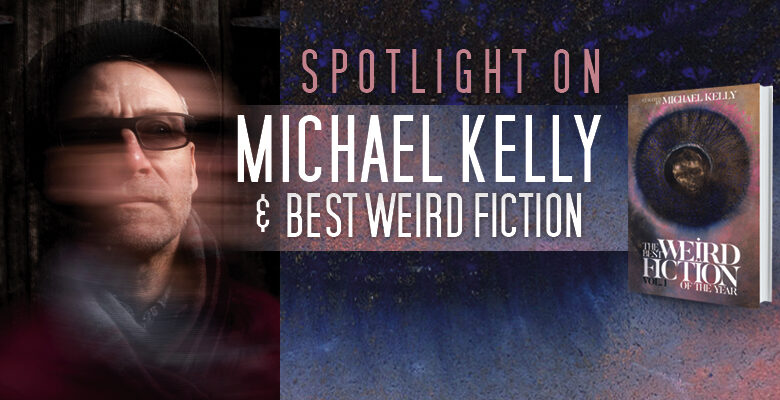
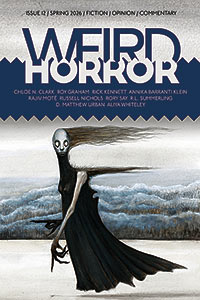
Michael Kelly curates The Best Weird Fiction of the Year and is former Series Editor for The Year’s Best Weird Fiction. He’s a World Fantasy, Shirley Jackson, and British Fantasy Award winner. His fiction has appeared in a number of journals and anthologies, including Best New Horror, Black Static, Bourbon Penn, Nightmare Magazine, The Dark, and The Year’s Best Dark Fantasy & Horror. He is the owner and editor-in-chief of Undertow Publications, and editor of Weird Horror magazine.
You’ve just launched the latest anthology series for ‘‘year’s best’’ stories in weird fiction, The Best Weird Fiction of the Year Volume One. Tell us about the series.
I’d previously acted as Series Editor for The Year’s Best Weird Fiction (2014 – 2018). It was a volume dear to my heart. It was a massively time-consuming and expensive series to produce. Each volume had a different guest editor, and we were selecting stories from major venues, and paying (in some cases) rather large sums for limited reprint rights. I loved the series; loved doing it. It won a British Fantasy Award. But I simply ran out of money and energy.
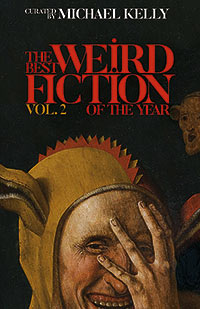
I’ve always wanted to revisit the idea. So I have. The new iteration is a scaled-back version. There’s no guest editor, and selected stories receive a small honorarium. It means that I’m unlikely to acquire stories that have appeared in Big Five anthologies and collections. In fact that happened with this first volume. There was a story I wanted, but the rights were prohibitive.
As with the first iteration of this series, I am hoping to provide a home to often unclassifiable modes of fiction that were not, in my view, being represented in other ‘‘Year’s Best’’ or ‘‘Best Of’’ anthologies. A dedicated volume of the weird. An anthology to fill some of those genre gaps. To be sure, there is no shortage of ‘‘Year’s Best’’ anthologies. Some quite good. And some, like Tenebrous Press’s Brave New Weird, and Neon Hemlock’s We’re Here, are actively filling some of those gaps and are well worth your time. But there will always be gaps. Some driven by commercial market concerns, some by taste and aesthetics. This new volume will strive to be in conversation with those other anthologies, while hopefully providing its own distinct voice.
I’m interested in voices and stories from the speculative margins, from new authors. New perspectives and ideas that challenge our notions of story and language.
What is weird fiction, especially as compared to horror, and what do you love about the genre?
Ah, that’s the question, isn’t it? Weird fiction is a large umbrella, encompassing many modes of fiction.Before genre rules were established, weird fiction could be said to consist of the science fictional, the ghostly supernatural, the mythical, the cosmic, and the fantastic. An extensive mode of literature. In that regard it shares many properties with its horror brethren. Weird Fiction, I believe, exists in the interstices of speculative fiction. Interstitial fiction, of a sort. It works to explore and subvert the laws of nature, or the natural order. An intrusion or inversion of the other into the known and recognizable world. I like to think of it as an unceasing distortion and buckling of ambient space and time. An unsettlement. It differentiates itself from its horror brethren in the sense that horror, notably, often concerns itself with malevolent and injurious forces, while weird fiction doesn’t necessarily. Weird fiction can often be unclassifiable and hard to precisely define. You’ll get varying definitions from different people. More than any other mode or stream or genre of fiction, The Weird is a feeling. It’s fluid, adaptable, and ever changing. I take a more expansive and less ‘‘tentacled’’ view of Weird fiction.
Tell us about your earlier volumes in a similar vein, and what kinds of changes you’ve observed in weird fiction over the past decade or so.
As mentioned, the previous volumes employed different guest editors: Laird Barron, Kathe Koja, Simon Strantzas, Helen Marshall, and Robert Shearman. In my view, this would ensure a fresh take on the mode each year. And it did. Each volume was vastly different, as each editor brought their specific sensibilities to the project, yet each stood as an example of the breadth and diversity of the genre.
My biggest challenge with the new volumes will be to try and put aside any of my biases and deliver a fresh, new book every year. A large part of my remit with a ‘‘Best Weird’’ fiction anthology is to offer new voices and stories each volume. I think this first volume of The Best Weird Fiction of the Year succeeds on that mark.
Perhaps one of the most notable changes in the last decade or so is that weird fiction is regularly turning up in nongenre and literary venues. I’ve taken stories that appeared in Masters Review; Sand Hills Literary; Washington Square Review; Conjunctions, etc. I think this is because readers and editors are realizing there is more to the genre than just the Lovecraftian. And in this sense I think it’s more accessible to some. And it’s more accessible to writers, as well. Many have embraced a chance to explore the outré. So I’m seeing more experimental fiction with the trappings of the Weird. A shift away from the more overtly cosmic to real-world irrealities, and a shift to ambiguity. A sense that in these times we don’t necessarily need or want our fiction to be neat and tidy and wrapped in a bow. It’s a messy, unexplainable world. The Lovecraftian tales I do see are inversions, flipping Lovecraft’s views of race and eugenics on its head, and challenging those obscene notions. Thematically, I’m seeing stories of climate catastrophe, authoritarianism, poverty, bigotry, and identity.
You’re also a fiction writer. What’s next for you in terms of your own books and stories?
I’ll have a few stories out in 2026 in Bourbon Penn, Supernatural Tales, and Nightmare Abbey, and have a couple other stories out on submission. I tend to write in fits and spurts and all five of those stories were written in 2025, four of them in a two-month span. Unheard of for me as I’m a notoriously slow writer. I have enough stories gathered for a new collection which I may try and market. I have three previous collections still available for interested readers: Scratching the Surface, Undertow and Other Laments, and All the Things We Never See.
– Michael Kelly
 Show your support of Locus, by donating during our Year-End Giving Campaign! Your gift today keeps the magazine full of all the book recs, fiction reviews, author interviews, and industry news you love to read. Plus the website, Locus Awards, writing workshops, and more. We have a match challenge till the end of the year — double the impact and donate today!
Source link


