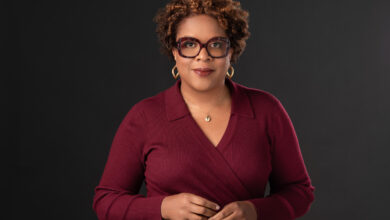
Good Intentions author Marisa Walz loves suspense and book clubs

Marisa Walz is a Chicago-based Federal Reserve executive by day who writes suspenseful novels about people behaving badly by night. Her debut novel, Good Intentions, has been called “razor-sharp tension and surprising twists” by Jeneva Rose. It follows Cady, a successful event planner whose life collapses after the sudden death of her identical twin. Instead of grieving, she becomes fixated on Morgan, a grieving mother she meets at the hospital, convinced their meeting is no coincidence. As her attachment deepens, compassion gives way to obsession, pulling Cady into dangerous moral territory.
We asked Walz to answer our recurring My Reading Life Q&A so readers could learn about the books that shaped her life and influenced her debut book.
What was the first book you were obsessed with as a child?
So many come to mind. The Giver really stuck with me, and I adored the Little House on the Prairie and Anne of Green Gables series. But The Secret Garden by Frances Hodgson Burnettis is the one most deeply ingrained in my childhood memories. I couldn’t tell you much about the plot now, but I read that book to pieces—over and over and over—so it definitely sparked something in me. It was enchanting and eerie, sad and uplifting…I love when a book is many things. And something about Mary Lennox spoke to me. Her loneliness maybe, or watching her bloom into someone new and better—it made me feel like maybe I could, too.
What book helped you through puberty?
I don’t know if it was any one book so much as it was books in general. Books are many things, not “just books.” Especially for a girl like the one I was, so intensely…interior. Books could be an escape hatch, a seed, a blueprint, a lesson… I was obsessed with slipping into other worlds, imagining myself inside the lives of characters who seemed wiser, stronger, or more interesting than I felt. Every book, every character, felt like a possibility for who I could become one day, a peek into the kind of life and adventures I could have. I experimented a lot with genre in my teen years—God, that sounds dorky—reading everything from classics to Sweet Valley High to Harlequin romance novels. I went through a big Mary Higgins Clark phase, too, that surely played some role in where I’m at today. The first book of hers I read was Where Are the Children?—a pretty sad and scary and heavy read for a young, sensitive girl. But I was instantly hooked and eventually read everything she ever wrote.
What book do you wish 18-year-old you had read?
Well, to the best of my knowledge, it doesn’t exist, but an inspirational self-help book or memoir called Everything Is Going To Be Okay would have been a godsend. I remember that age being fraught with anxieties and insecurities, I wish I hadn’t burned so much time and energy on. But I suppose that’s one of the perks of growing up. You can’t truly appreciate how good it feels to be self-assured or content—or to not give a damn about every little thing—unless you have the perspective of having once been someone who wasn’t very self-assured or content and who gave a whole lot of damns.
If you were to teach a class on Damn Good Writing, what books would make the syllabus?
I’ve read so many craft books and most are fantastic and give me something to take away, but I’m a believer that the best way to learn how to write a damn good book is to read a damn good book. Lots of them, actually. So here are a couple masterpieces that inspire me, as well my vote for the ultimate craft book:
The Push by Ashley Audrain. This book captured me from the first line (it promises a very specific vibe and emotional payoff) to the very last (where it delivers spectacularly on both fronts). This book is perfection for me—dark and eerie with tons of heart (and heartache), beautiful prose, intense character depth…I savored every single line.
Tomorrow, and Tomorrow, and Tomorrow by Gabrielle Zevin. I don’t enjoy video games at all and anything techy gives me the yawns, so how—how—did I end up loving this story as much as I did? Because it’s damn good writing. It’s a case study in character development, voice, and gorgeous-but-not-pretentious prose. It proves that if you give readers authentic, interesting characters, they’ll follow you anywhere—even into a video game love story.
Save the Cat Writes a Novel by Jessica Brody. I don’t follow the template as strictly as I used to, but it remains the single most helpful, influential craft book I’ve read. It demystifies structure and gives you a storytelling map—one you can adapt, tweak, or ignore once you understand the how’s and why’s of it. The fundamentals are part of my storytelling DNA now.
What books helped guide you while writing your book?
I’m going to double down and cite The Push again. It didn’t guide me, though, so much as inspire me. Literally: the night I finished The Push, I could not sleep. Not until I’d figured out a way to write a story that would make readers feel the way that one had made me feel. Thrilled and devastated and terrified and hopeful—and then—that gut punch of an ending. I had to recreate that energy somehow. So I took a story that had been simmering in my brain for years and mashed it up with the mood and dread and emotional voltage of The Push, lying awake all night until I had it all figured out—the map for what would eventually become Good Intentions.
I also pull out The Emotion Thesaurus by Angela McKerman and Becca Puglisi often—it’s indispensable when I feel myself defaulting to too many sighs, raised eyebrows, or other emotional shortcuts. It pushes me toward fresher, more embodied forms of expression for my characters.
What books are on your nightstand now?
I mainly read a mix of suspense and book club fiction, because each scratches a different itch. I just finished The Bright Years—fabulous—and Charlie Donlea’s Guess Again. Detective novels usually aren’t my thing (those pesky cops with their tiresome this and procedural that) but wow, was that book good. Right now I’m reading The Correspondent because Bookstagram insisted I had to, and I am not regretting it one bit. And on deck are two debuts from my St. Martin’s Press sister authors—A Good Animal by Sara Maurer and Lady Tremaine by Rachel Hochauser. They’re both racking up raves, and I’m so eager to dive in!
Related
Source link