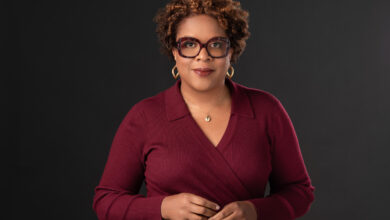
Q&A: Sarah Domet, Author of ‘Everything Lost Returns’

We chat with author Sarah Domet about Everything Lost Returns, which is the story of two women separated across time but united by the arrival of Halley’s comet, as blazing and as daring as their stories.
What’s most striking to me about this novel is that it takes place in two different time periods, 1910 and 1986, both years when Halley’s comet appeared. How these stories ultimately come together is both beautiful and unexpected (no spoilers, I promise!). Can you tell us a little about which of these two braided stories came to you first, and when you first knew that they both belonged together?
Initially, I set out to write a novel based loosely on the life of Victoria Woodhull, who is best remembered as the first woman to run for president in 1872, with Frederick Douglass as her running mate. Like other feminists of the era, she was also a spiritualist who channeled spirits and communed with the dead. While reading her biography, I learned that she used her spiritualism as a public platform for her private voice. This is the moment Opal’s character came into perspective for me: She wasn’t just an ambitious woman; she was a spiritualist who learned to throw her voice, as it were, so that others could say what she herself could not. From that point forward, I was less interested in the historical figure who inspired Opal, and more interested in how women manipulated public platforms for personal gain.
While Opal’s story was the first to arrive, it was the most difficult to grasp. Nona’s story arrived more fully formed. I immediately envisioned her as an actress, someone whose most famous role was that of the Earthshine Girl, famous face of the fictional Earthshine Soap. As a child, her image was used to sell a product, and, as such, she became complicit in perpetuating the very values that, in her personal life, she resisted.
In Everything Lost Returns, Halley’s Comet is less a plot point and more a structural necessity that helped me explore intergenerational connections between these women.
As you mentioned, both of these women work for the same (entirely fictional!) soap company, Earthshine. You grew up in Cincinnati, where Procter & Gamble is based. Was that an inspiration for you?
Absolutely. Soap is big part of my hometown’s lore. As a kid, I often passed the Procter & Gamble headquarters in downtown Cincinnati. In TV commercials featuring all those P&G products, women happily labored in their perfectly crisp outfits, sinks full of suds.
For the most part, my own mother was one of these women–a “stay-at-home” mom. Both of my grandmothers, however, were factory workers. My maternal grandmother dropped out of school in the eighth grade and ultimately wound up at the factory where Frank’s RedHot was made; my paternal grandmother, who immigrated to the U.S. from Lebanon, cut fabrics in a uniform factory. When my daughter was born, I quit my teaching job for two years to stay home with her. It was during this time that I wrote the first draft of Everything Lost Returns. I’d been thinking a lot about the generational sacrifices that made my life as a writer possible–and this book attempts to examine “women’s work” in all forms.
Speaking of soap, each chapter opens with a slogan from a real soap company. Where did you find these? What did you learn from digging them up?
Most of the old vintage ads I found through internet sleuthing. As I began collecting, I learned that soap advertisements across the centuries sold very racist, sexist, “traditional” values. This should surprise approximately nobody. However, seeing the cumulative effect felt notable, as the ads seemed to ask: What does it mean to be a good woman? What does it mean to be pure? How can a woman “trick” a man into compliance? How can women use the domestic sphere to “control”?
Advertisements that on their face appeared to reclaim female agency bought into the values of the very system they were trying to disrupt. For the purposes of my novel, I imagined these slogans as a sort of psychological backdrop, a reminder of the persistence of this kind of target marketing in our lives.
Earthshine would be nothing if it weren’t for the women who bought its products, or for the women who work in its factories. These women, both the consumers and the workers, come together to form these beautiful and moving communities of resistance. As you wrote the novel, how did you think about where Opal and Nona fit in with these outspoken women?
I was working on an early draft of this book around the time of the Women’s March in 2017, which I didn’t attend, but friends sent me pictures of themselves in the swarm of a crowd. I believed I was a good feminist, but I was at home raising my first baby after quitting my day job. I thought a lot about communities of resistance–then and now–and what kind of world my daughter could hope to find waiting for her.
Opal’s life had been shaped by loss. However, after a romantic encounter with Madame de Fleur, after which she learns she’s pregnant, she becomes willing to move toward the life she wants, at great risk. She accidentally finds herself the de facto leader of a factory strike. I say accidentally, but I don’t think it’s an accident at all when one is living according to her values. As Opal tends to her own needs for the first time, she begins to gather a community of resistance around her.
Although Nona is born into an era where she has significantly more choices than Opal, she’s initially less evolved. She’s willingly bought into the script produced by the culture–she’s been a “good girl” all her life, following the rules, striving for perfection. When her friend dies and leaves her a mysterious notebook from Opal Doucet, she’s set on a new course to discovering her own agency. Only then can she be a voice for other women.
Both women ultimately resist. Opal organized a movement that, seventy-six years later, Nona finally joins.
Opal undergoes a transformative experience with a spiritualist, Madame de Fleur. Even after Madame de Fleur moves to Paris, the two stay in touch, and Opal begins to incorporate some of her spiritualist teachings into the cures she offers to fellow factory workers. What kept you coming back to spiritualists? What research did you do in order to bring Opal and Madame de Fleur to life?
Mostly I love these spiritualists because they’re bad asses–and I’m drawn to badassery, especially in women who have been historically forgotten.
Many 19th and early 20th century female spiritualists defied traditional gender narratives, hiding their own beliefs behind their spirit-world gatekeepers. In 1924, for example, Mina “Margery” Crandon became the subject of much media attention when Sir Arthur Conan Doyle, one of her most fervent advocates, encouraged her to enter a contest sponsored by the Scientific American. The contest offered a $2,500 prize to any medium who could pass the investigations of its five-man committee, which included Harry Houdini. Margery didn’t win the money, but she came close–and, oh my goodness, I love her so much.
Not all of my research made its way into the book, but I tried to capture the spirit of these women and the way they carved out power in a world that seemed set on denying them any.
You are clearly so interested in and inspired by these lady spiritualists of the late 19th and early 20th century! I have to ask: Do you believe in a spirit realm separate from our own?
I will neither confirm or deny my ability to commune with the other side.
Halley’s comet isn’t expected to reappear until 2061. I hope we get a new novel from you before then! What are you working on now?
I’m feeling optimistic about those chances! I’m working on a third novel about a cult leader who goes missing and the speech writer who assumes her identity.
Will you be picking up Everything Lost Returns? Tell us in the comments below!
Source link