200 Monas author Jan Saenz is reading a smorgasbord of books

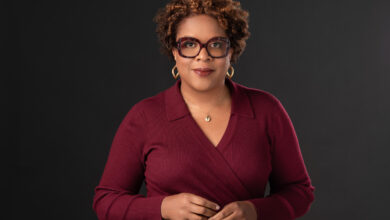
Jan Saenz is a Houston-based author, poet, and educator whose debut novel, 200 Monas, is a riotous adventure that oscillates between feeling like a panic attack and getting a stomach ache from laughing so much. Pitched as being for fans of Phoebe Waller-Bridge and Miranda, Saenz follows Arvy Keening, a college senior who discovers a stash of a powerful pleasure-inducing drug in her dead mother’s closet and is given 48 hours by two dealers to sell all 200 pills or die, sending her and the campus dealer Wolf on a frantic, chaotic race through their college town that forces Arvy to confront buried grief, risky desires, and the strange ways people cope with loss.
We asked Saenz to answer our recurring My Reading Life Q&A so readers could get to know the books that shaped her life and influenced her writing.
What was the first book you were obsessed with as a child?
Eloise. My grandmother used to read it to me. I remember feeling very akin to Eloise. Like her, I lived in my imagination constantly. It was kind of a problem. Back then, I didn’t think much about why Eloise spent so much time in her imagination. Now, I understand: Eloise was lonely. You’re never lonely in your imagination. There will always be something or someone to play with. Even in the dark, it finds a way to tell you you’re not alone, directing your eyes toward the closet, the shadows, strange sounds. I still have a lot of Eloise in me. I still say things like, “I’m gonna go take a bawth.”
What book helped you through puberty?
Movies helped me through puberty, not books. However, if I had to choose, I’d say the Fear Street series. Adolescence is kind of horrific, no? There is so much change happening, so much uncertainty. Am I pretty? Is my body normal? Do my friends like me? What if my parents die? Reaching for horror novels, I felt empowered—that feeling of I can handle dark things. I liked that the girls were pretty and popular, that they had boyfriends. I liked that they were all victims of something, a relatable feeling when you’re young, vulnerable, and somewhat resourceless. Fear Street was a gateway drug to Go Ask Alice, V.C. Andrews, and even the tattered 70’s smut novel that lived in my parents’ closet. I loved that novel; I was always sneaking off to read it.
What book do you wish 16-year-old you had read?
What the Living Do by Marie Howe. I think 16-year-old Jan would have liked those poems—confessionals about memory and sexuality, death and grieving. In my youth, sexuality felt ever-present—woven in the fabric of everything—and not always in a healthy way. It was always lurking just outside my peripherals; I was never sure if it wanted to hug me or snatch me, which was confusing. But also, exciting? Like discovery? Howe’s poems are so masterfully simple, yet not simple at all. I think teenagers appreciate that ingredient in literature because it makes them feel smart about analysis, which is important.
What book do you think all teenagers should be assigned in school?
I think plays should be on the syllabus every year, from elementary to high school. Reading dialogue aloud is such a powerful conductor of energy—a table read can transform a classroom! So many students struggle with reading comprehension, which erodes their confidence in English class. I say, Give them a play! Something to act out and analyze as a group. I think every teenager should study Hamlet and MacBeth, and yes, The Crucible, but we need to give them more modern works that they can see themselves in, to reinforce a shared love of reading. I’d love to see Sarah DeLappe’s The Wolves and John Patrick Shanley’s Doubt taught in high school.
If you were to teach a class on Damn Good Writing, what books would make the syllabus?
It would be a mix of books, short stories, scripts, and poems. Toni Morrison’s The Bluest Eye. Lolita. Some Graham Greene and Jeffrey Eugenides. Maybe something fun like The Song of Achilles by Madeline Miller, or Perfume and Pain by Anna Dorn, which I just finished. Aaron Sorkin would make the list—I’d assign the opening scene of The Social Network or, selfishly, Steve Jobs. For a short story anthology, I’d assign The Vintage Book of Contemporary American Short Stories. Also, “Virgins” by Danielle Evans. “Biology” and “Wildfire Johnny” by Kevin Wilson. “The Husband Stitch” by Carmen Maria Machado. In poetry, I’d reach for Lucille Clifton and Sharon Olds. Jericho Brown’s The Tradition. Richard Siken’s Crush. It would be a long syllabus that I would shed tears and lose sleep over, forced to whittle it down for time.
What books helped guide you while writing your book?
I was teaching fiction part-time while writing 200 Monas, mostly short stories, meaning that every week, I had to fall back in love with rudimentary craft elements and plot structure analysis for the sake of teaching. I find that revisiting short stories on a regular basis is a great way to remember what makes for good storytelling: concise, economical writing that honors forward movement, structure, and theme. Also, I read a lot of romance and new adult novels during that time, which was a great reminder that love stories are fucking fun. James Cameron once said, “All my movies are love stories.” I could say the same for everything I’ve ever written. If I were going to shoutout one book, I’d give props to Refuse to Be Done by Matt Bell. It’s a great craft book for all levels, whether you’re writing your first novel or your fifth.
What books are on your nightstand now?
Oh, it’s a smorgasbord. The Marriage Plot by Jeffrey Eugenides. Exit Lane by Erika Veurink. Cruelty Free by Caroline Glenn. In ebooks, I’ve got an ARC of The Outer Country by Davin Malasarn, which comes on in May. In audiobooks, I’m about to start Between Two Fires by Christopher Buehlman. Do I normally read this many books at one time? God, no. But I haven’t read in so long; I’ve been writing! It’s reading season.
Related
Source link