
Indies Introduce Q&A with Alice Evelyn Yang
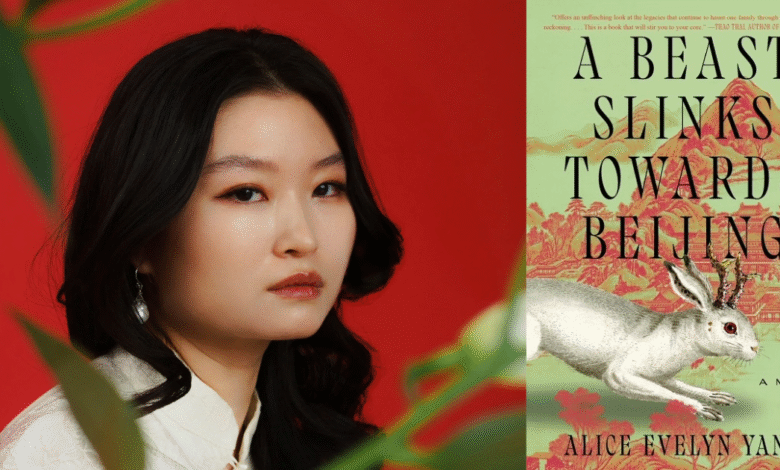
Alice Evelyn Yang is the author of A Beast Slinks Towards Beijing, a Winter/Spring 2026 Indies Introduce selection.
Haley Calvin of The Novel Neighbor in St. Louis, Missouri, served on the panel that selected Yang’s book for Indies Introduce.
“I have never been as in awe of a book as I am after I finished reading A Beast Slinks Towards Beijing! Alice Evelyn Yang weaves generational trauma with the mystical in this sweeping family saga, told over three generations from Japanese-occupied Manchuria to modern day New York City. An absolutely heartbreaking novel that I will never get over, this debut is not one to miss,” said Calvin.
Yang sat down with Calvin to discuss her debut title. This is a transcript of their discussion. You can listen to the interview on the ABA podcast, BookED.
Haley Calvin: Hello, everyone! Welcome. My name is Haley Calvin. I’m the Assistant Director of Events at The Novel Neighbor. We are a woman-owned and independently operated bookstore in St Louis, Missouri.
I’m super excited for this interview because I have the honor of introducing and talking to Alice Evelyn Yang for her book, A Beast Slinks Towards Beijing, which was an Indies Introduce selection for this season. I had such a great experience doing the Indies Introduce panel with everyone, so if you haven’t done it yet, you need to sign up now to do it because it was such a fun time.
I’m very excited to spend this time with Alice, who is a Chinese-American writer from Norfolk, Virginia. Her work has been published in MQR, AAWW’s The Margins, and The Rumpus, among others. She is the recipient of the 2022–23 Jesmyn Ward Prize from MQR [Michigan Quarterly Review] and completed her MFA in Fiction in 2022 at Columbia University, where she was awarded the Felipe De Alba Fellowship and nominated for the Henfield Prize. This is her first novel.
Everyone welcome, Alice Evelyn Yang!
Alice Evelyn Yang: Thank you so much for having me! Being a part of the Indies Introduce list has just been so wonderful. I always love frequenting my local bookstores or going to local bookstores wherever I’m traveling. I really think that indie booksellers are the backbone of the book industry right now, especially with Amazon and all these other monopolies coming in. I’m so honored to get to talk to you Haley!
HC: During the [Indies Introduce] process, when we were going through all of the different manuscripts, I saw A Beast Slinks Towards Beijing on our list and I got so excited. It was one of those books that I’ve been highly anticipating. It was a very exciting part of this process, that I was able to read it early and as a manuscript. I was very excited and I was very excited to get to talk to you, because I had such an amazing time reading Beast, it just moved me to tears.
What inspired you to write A Beast Slinks Towards Beijing?
AEY: I came up with the idea for A Beast Slinks Towards Beijing in undergrad, it was probably around 2021 at the time. For context, I turn 28 next month. It’s been a process and it’s been years in the making.
I came up with the idea during a period of my life where I was reading a lot of family sagas. So East of Eden by John Steinbeck and Pachinko by Min Jin Lee are the ones I cite the most often because they had the biggest impact on me at that age. I talk about this a lot as a second-generation immigrant: my parents never really opened up about their past or about their parents, and my interactions with my grandparents have been pretty limited.
At some periods of my life, they came to stay with us in America, but I didn’t even know their Chinese names, I always just refer to them by their titles — Lao Lao and Nai Nai. They’re both intimate figures and also strangers. All those silences created a lot of curiosity in me, and I wanted to envision a family history that could be mine.
The crux of A Beast Slinks Towards Beijing is this question of, “How do you deal with and reckon with trauma, especially intergenerational trauma, when you don’t know what it looks like?” So, writing A Beast Slinks Towards Beijing was taking pieces that I had learned from my parents, these little morsels of information that they would give me. For example, my dad would suddenly drop lore randomly during a road trip, like, “Oh yeah, my family actually had this apothecary empire.” And I’d be like, “What? What do you mean?”
HC: Dad lore just dropped!
AEY: I know! This happens with my friends who are also second-generation immigrants too. My friend would be like, “Yeah, my dad just told me that he had to kill his own dog during the Cultural Revolution” because he also read A Beast Slinks Towards Beijing and he’s like, “This reminds me of the time that I had to kill my own family pet.” And I was like, “Oh, what a surprise, what a fun family conversation!”
For me, it was filling in those gaps and understanding the history that I came from, especially growing up in America for most of my life, I never actually learned about these periods of history either.
I grew up in Southern Virginia, which you might have guessed if you read the book, but that education was very Western and even perhaps a bit problematic, especially because it is a conservative area. For me, I just wanted to learn more about that history and kind of act like I was slipping on my parents’ skin or my grandparents’ skin, and envisioning what kinds of history they lived through.
HC: When you were writing it, did you talk to your parents more about their experiences as you were exploring it through Beast? Did you do your own familial research?
AEY: I did. I wrote this book when I was in my early 20s. I believe I started writing it when I was 22 or 23. Right out of college I went to grad school for my MFA, and I started creating these scenes that would later become A Beast Slinks Towards Beijing. Although the first drafts of those have been changed just so much that they bear no resemblance to the final product.
But the idea of it I started when I was quite young. There’s that saying, “Write what you know” — I don’t always believe that to be true, but I do think when you don’t have as much life experience you are writing and drawing from pieces of your life, and so for me, I talked a lot to my dad. I think you might not guess this from my book, but my father and I are quite close.
HC: I love that for you!
AEY: Yeah, everyone’s like, “How bad are your daddy issues?” And I’m like, “You know what? I think everyone has some extent of daddy issues, but it’s not that bad.”
My dad reads a lot and he reads a lot of literature in Chinese. I think, because of that, he understood what stories I was looking for and was really open with me about his past. If I had specific questions he would answer them, and some of it wasn’t even related to his life. I would ask, “What were the apartments growing up in the city? Where was the bathroom?” Because a lot of the apartments didn’t have their own bathroom, it was a communal bathroom.
My mom was a lot more silent. You can kind of see that in the mother figure of the book as well. She is very much like, “I don’t want to talk about this period of my life anymore. I’m fully American now.” I think that’s reflected a bit in that maternal character.
But my dad was so helpful. He helped me find archival material, and he would browse these forums about people recalling their past in Chinese. My reading and writing of Mandarin are not great, so having him translate those texts was really helpful for me during the research process.
HC: That’s so cool! I feel like that’s an amazing way for you to be able to connect with your familial history and your own father as well. That’s so special.
As you said before, Beast is a family saga, and you briefly mentioned going into the historical context of the book. Can you tell us a little bit about how you did the research into the historical aspect of the book?
AEY: Yeah, so as I mentioned, I talked a lot to my dad. He pointed me in the direction of archival material in Chinese, such as primary source texts or forums where people are recalling their past in the Cultural Revolution. But I had to do a lot of my research in English, right? Because reading Chinese is not my strong suit. I can speak it.
I think that’s the experience of a lot of diaspora kids, they can speak fluently but reading and writing is really hard. I read a lot of secondary sources. I read all of Frank Dikötter’s work, I scoured his whole canon. He wrote a lot of books on The Great Famine, the Cultural Revolution, and even going back to the Japanese occupation, as well as Japanese-Chinese relations.
I read a lot of academic texts. I was lucky that I started doing the writing while I was at Columbia, because they have an East Asian library. I would dig through the stacks of these books that had clearly never been checked out, or had been checked out twenty years ago, and that was really lucky for me.
I have a lot of issues with the MFA programs, but I think that having access to all those academic resources was great. Right now, I’m doing research for my second book, and it’s a lot harder when I don’t have access to these databases like JSTOR and ProQuest.
I was really lucky that I got to find all these articles and all these scholarly journals that talk about anything I wanted, like integration of folklore and fate. I read this whole book on fox demons in post-Imperial China.
It was a lot of reading. I obviously wish I could have dug into archives in China or done archival research there, but I did start this in the pandemic and also because I’m writing about the Cultural Revolution, there are censorship issues with doing actual research in China, so I did a lot of secondary source research, and then talking with my dad.
HC: What was the most shocking thing that you learned while you were researching?
AEY: For me, it was a lot of the violence that occurred in the Cultural Revolution as well as the violence inflicted by the Japanese Kwantung Army. It wasn’t new to me, but I think when I first learned about these incidents, it was quite shocking.
There’s Unit 731, which I wrote a short story about in The Rumpus, about Japanese scientists doing human experimentation on the Chinese people while they were occupying Manchuria. Then the Rape of Nanking, I read Iris Chang’s book on that and that was quite shocking.
I didn’t learn about the Cultural Revolution until much later in my life, and I think the violence that occurred there, especially that was being propagated by these teenagers, was really shocking. Everything that I wrote about — the violent incidents that happened during Red August and during the Cultural Revolution — those are all things that happened. I remember my editor and agent were like, “Oh, do you think this might be a little too grotesque?” And I was like, “These were lifted straight from practice. This is the history. I know it sounds like quite extreme, but [these] things actually happened during that period of time.”
HC: Beast also has a mythological air to it. As you were researching, what was like your favorite mythological thing that you researched?
AEY: For me it was the fox demons. It’s because of the connotations of feminism and patriarchy that come with Chinese conceptions of fox demons. I think they’re very much vilified as the sort of like Madonna-Whore complex that was very prevalent during that time. That was really interesting. I did really enjoy doing a lot of the mythological research. It was a lot of reading about Japanese folklore and Japanese demons, as well as Chinese demons and Chinese prophecies. But the fox demons are really interesting in particular, because I think they’re just a reflection of men’s fears about women at the time.
HC: Yeah, I really love historical novels specifically for the research that goes into them. It’s so exciting listening to you talk about what you researched.
The one thing I miss leaving college is the access to all of those databases. If I want to research something specific, I can’t really do that anymore so I totally get that. I feel like you are so much smarter with the way you research, and yours is more intentional. I really love hearing about your research process.
AEY: Thank you! Yeah, I just love JSTOR. I love the movie Midsommar, and there’s a quote in there where he’s like, “You’re a grad student, and I had to teach you how to use JSTOR.” I think that’s so iconic, because truly, what are you doing if you’re in grad school and you still don’t know how to use JSTOR?
HC: Oh, so truly, I have only done my undergrad, and even I was like, “Okay, I do feel like this is a life skill to know how to do this.”
On top of the research, like I said before, this is a family saga, and your characters in Beast are truly just the most well-rounded characters I’ve ever read in a novel. They feel like people to me.
I am really interested in how you crafted your characters, and how you were able to weave their stories together through three different timelines?
AEY: I think the first scenes I wrote were actually the basis for chapter one, with Qianze and Weihong colliding after they were estranged for so long.
Once I had this seed of an idea, I began writing with Ming, because my idea for the novel is like a Russian Nesting Doll. I wanted to start with what it was chronologically first, and that would be Ming, because I really wanted to show how the trauma was passed down from Ming to Weihong, and how her actions and what she survived influenced how she was a parent, how her parenting affected Weihong, and how the historical time period that he lived through affected him as a parent. It’s sort of this nesting doll, right? Each subsequent generation carries what came before them. To do that, I had to know exactly what was coming into the new generation.
So, I began chronologically with Ming, and there were some historical events I wanted to cover. I had this historical timeline. I wanted her to live through the Japanese occupation, especially because I don’t think this is a period of history that is really talked about in the West. I wanted to cover these events, such as the Japanese occupation in the Second Sino-Japanese War especially, because in terms of time these events aren’t really too far away. There are still Chinese Comfort Women and Korean Comfort Women who lived through that time, who are still alive today.
Just writing through those events, having those touchstones, and then envisioning a character living through them is sort of how they were formed. It’s really interesting, because sometimes the characters would do something different than what I had plotted, because they had taken on their own personality. I would tell this to non-writers, and they would be like, “What? What do you mean? The created persona in your head has chosen to do a decision that you didn’t decide on?”
But as I was writing them, I was learning more about them, and they develop their own decisions and their own mindsets. I learned about them as I wrote them; I didn’t have them preconceived. I had some basics but I’m really more of a discovery writer.
I wrote everything chronologically: I wrote Ming’s timeline, and then Weihong’s childhood, and then Qianze’s present day. I took stock of what I’d written and tried to find the interconnective tissue between those and how I wanted to reveal things. I don’t know if I would go through that writing process again.
HC: That sounds like a lot!
AEY: It’s very much a patchwork quilt. Something I was never told about historical fiction is that you have to research the most minute things. I was like, “How do they carry around water? They obviously didn’t have a Hydro Flask. What was the equivalent in historical times of a water bottle? Or what kind of diet did they have?” These very small things that you don’t think about and then would appear for like one sentence, but actually took a whole hour. I don’t know if I would go through this process again, it might be a while before I write a historical fiction.
HC: It’s so cool that you call it a patchwork quilt. It’s so interesting that you did it by generation and then wove them together. I feel like your brain is crazy, and I’m really into it. This book is just so good, you guys. You have to read it to believe it, if that makes sense; this is one of those books where it feels like a modern classic.
As you were talking about your characters and how they created their own personalities, it really comes off on the page. These feel like real people that feel like they’re experiencing human emotions. It’s very much like The Body Keeps the Score in inheriting trauma, and I find that genuinely so interesting. It’s so cool to go through different generations, exploring the same thing and how it affects different people of the same line.
What do you hope readers will take away after they read A Beast Slinks Towards Beijing?
AEY: My core audience is a lot of second-generation children, or people of the Chinese diaspora. I think it has a wider reach where I think you can take stock of your family history and understand what kind of trauma that has been brought to you and what might have been passed down. It’s not something you have to carry in the future. It’s the message that you can break these generational cycles and be better than what you were taught and what you inherited.
I also hope that readers understand that period of history more. There are so many World War Two novels from a Western perspective. To see the same period of time from Asia, and how imperialism was occurring on the other side of the Pacific, I hope it inspires readers to do a deep dive into authors who are writing about that time — who maybe are translated or writing in non-Anglophone languages.
I certainly read a lot of translated Chinese literature from authors like Mo Yan and Yan Lianke. I hope it creates a curiosity that people indulge, and encourages them to learn more about these histories that we aren’t necessarily taught.
HC: I definitely agree. I think that’s really important to look outside of your lived experience, and I think it’s really important to be more worldly. [This book] was really enlightening.
AEY: Thank you so much. Also, when you were like, “I’m so astounded by your brain,” I found that really funny, because I’m currently going through such brain rot. The brain that wrote A Beast Slinks Towards Beijing is not the same brain that I have now.
HC: You are also chronically on the internet, and you do have an alter ego online as @rot.and.read, where you make hyper-specific book recs. You truly just kill it with every single one of your book recs. I’d be interested to see what hyper specific book recs that you would give to your characters.
AEY: Thank you! Yeah, I started @rot.and.read. because I realized I have this secret skill where I’m able to recall a lot of book summaries and book descriptions.
It’s the one thing that sticks in my brain, along with lyrics from the early 2000s. I can recall all the lyrics of Black-Eyed Peas, and also all these random book descriptions, along with like the soundtrack of Hamilton. This isn’t a book rec, but I would recommend all the characters of A Beast Slinks Towards Beijing get therapy.
I would recommend all those characters read What My Bones Know by Stephanie Foo. That’s a memoir of healing from trauma and exploring familial history. I think Ming would really enjoy female rage books, especially because she lived in a time where female rage was literally demonized. Titles like Out by Natsuo Kirino, and maybe some Bookstagram darlings, Chelsea G. Summers’ books or Eliza Clark’s books. I think she would really enjoy those, and get to indulge in her very well warranted female rage.
Weihong, would enjoy some Red Guard memoirs. I read those a lot during the research process, but Red Azalea by Anchee Min really stands out because the language is really lovely. Obviously, she was talking about these really dark historical times, but it felt more like a novel. I think those memoirs would let him know that he’s not alone, and that also his trauma isn’t special. For him, he mythologizes his trauma.
I would also recommend Pachinko by Min Jin Lee. That’s a wonderful book about a mother-son relationship, but from the perspective of the mother, and I really think that that might be healing in a way, to understand his mother’s perspective. Similarly, the graphic novel Grass by Korean writer Keum Suk Gendry-Kim. That’s a graphic novel about a Korean Comfort Woman. Those books [would help him] exercise empathy for Ming.
Qianze would really enjoy some late-capitalism critique. The book that comes to mind is probably Severance by Ling Ma. Obviously that book is from the perspective of someone in the Chinese diaspora as well, but I think she would be a big Severance girly, especially because, you know, her job feels very corporate. I think she would enjoy this idea of the metaphor of late-stage capitalism and zombies.
HC: As a bookseller, I really wish I had that skill of remembering everything. Whenever people come into the bookstore and they’re like, “Do you have this specific book rec for this specific instance?” and I’m like, “Oh, suddenly I’ve never read a book in my life.” So that is a skill and a superpower.
But whenever people come into the bookstore now looking for a book recommendation, I’ll be like, “No, you’re leaving with A Beast Slinks Towards Beijing.” That is the only book rec from here on out.
AEY: Yeah! Why don’t you start your new year with some intergenerational trauma? That’s what you need!
HC: Crying is in in 2026!
AEY: No brain rot, just tears.
HC: Thank you so much for joining me and answering all of my questions. I had truly so much fun.
AEY: Thank you so much for all the praise of A Beast Slinks Towards Beijing. It still feels quite surreal that the publication date is coming up soon, and I’m still like, “Oh, this is happening to someone else.” Talking to booksellers has been so wonderful, because, like I said, indie booksellers are truly the backbone of the book community. Right now, we all need that local reading community.
Thank you so much for speaking with me and getting to yap about a wide range of topics.
HC: We got to yap about trauma!
AEY: JSTOR and trauma.
HC: I know by the time everyone listens to this podcast, A Beast Slinks Towards Beijing will be out now so you can get it at your local independent bookstore. It is definitely one for the season. Please pick this book up if you like crying and trauma and history and family sagas. It’s a wonderful book, and it was even more wonderful getting to talk to you Alice.
AEY: Thank you, Haley. Thank you to all the booksellers!
A Beast Slinks Towards Beijing by Alice Evelyn Yang (William Morrow, 9780063419292, Hardcover, Fiction, $30.00, On Sale: 01/27/26)
You can learn more about this author at aliceevelynyang.com.
Source link


