
Indies Introduce Q&A with Ruby Martinez
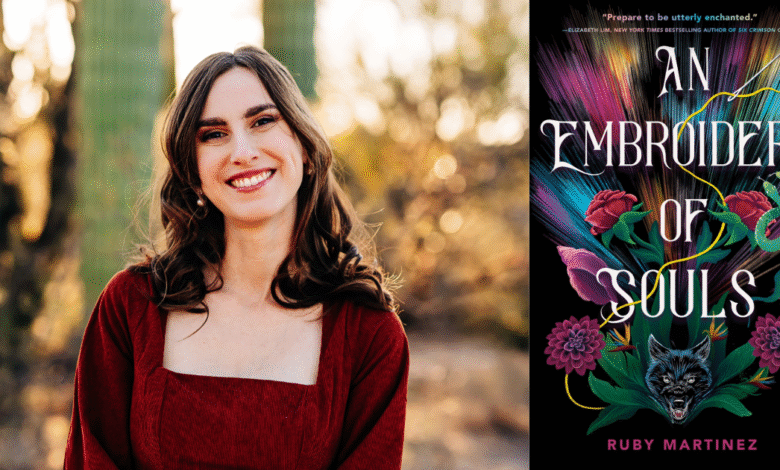
Ruby Martinez is the author of An Embroidery of Souls, a Summer/Fall 2025 Indies Introduce selection.
Keeley Malone of Ink Drinkers Anonymous in Muncie, Indiana, served on the panel that selected Martinez’s book for Indies Introduce.
“An Embroidery of Souls is a positively surprising fantasy with a rich meshing of cultures that threads in the magic of souls and embroidery in such a unique, magical way,” said Malone.
Martinez sat down with Malone to discuss her debut title. This is a transcript of their discussion. You can listen to the interview on the ABA podcast, BookED.
Keeley Malone: Hi, I’m Keeley Malone, owner of Ink Drinkers Anonymous in downtown Muncie, Indiana, and today I’m talking with Ruby Martinez. She is a Mexican-American writer who stuffs her books full of magic, romance, and mental health representation. An Embroidery of Souls is her debut novel. She works as a therapist by day and lives in the Southwest.
Hi, Ruby!
Ruby Martinez: Hello Keeley! I am so excited to get to talk to you. I’ve been looking forward to this.
KM: I’ve been super excited as well. I loved your book and I can’t stop recommending it. I can’t wait for it to come out. When we started the Indies Introduce panel, and I was assigned [to read this book], I got maybe five pages in and I was like, “I’m gonna love this.” I’m super excited that I could champion it and help move your book along in the Indies Introduce [process].
RM: This is so exciting. For anyone listening, Keeley is the one who called me and told me that I was an Indies Introduce author. I did not think that was actually going to happen. You were the first person I talked to who wasn’t a publishing person who was, in some way, getting paid to say nice things about my book. You were the first person who was like, “I really loved it.” I remember being in the car with my husband and tearing up like, “Oh my gosh, someone likes my book who isn’t a publishing person!” That’s super exciting and I’ve been very excited to talk to you ever since.
KM: I tell everybody that this is one of the best parts about being a bookseller.
RM: It’s a great part of being an author.
KM: What first sparked the idea for this story? What was the starting point when you began writing? Was it a particular scene, a character, or something else that inspired you?
RM: This is a great question. I think for all books, it’s very different. For me, there’s two answers.
The more meaningful one is: The character of Jade was very much a bedrock of what I wanted to write about, what this novel is about, and what inspired it for me. I love romantasy, love fantasy, love romance. I read a lot of it, and I got the idea for this novel during COVID when I was just unemployed in my house, with nothing to do for a whole year but read and write. I read a lot of books, and most of the heroines in those books — and I say this with all the love in my heart, because I love these heroines, I’ve written these heroines before — they’re all very badass, stabby-stabby, witty heroines. And I love that for them! But that is not me, and that is definitely not Jade.
Both Jade and myself are much more awkward, much more anxious, and definitely not the kind of person you see bumbling their way through a fantasy plot line. There’s something so incredibly meaningful for many people about being able to see ourselves reflected in books and reflected in the stories that we consume.
So I just was like, “Why don’t I put those traits into a book?” Why don’t we see someone who is awkward and scared and who’s having a really hard time with going on this really exciting fantasy adventure? She was very much the starting point for me. I wanted to put this kind of person in this position and have this adventure and get this great love.
I also had the idea for embroidery magic. Wouldn’t it be interesting if there was magic based on embroidery? I don’t embroider; I don’t know anyone who embroiders. I don’t know where that came from, but that felt exciting and cool and marketable — which is something you really want to have when you’re dying a slow death as an author in the query trenches.
KM: I really appreciated that Jade isn’t the typical heroine that we see in most of the fantasy novels we have. I wish we had more soft, realistic heroines that people can relate to. That’s really important. Was there anything in particular that drew you to embroidery as a centerpiece for your story?
RM: Honestly, I think it was just, “Oh, this is interesting. Wouldn’t it be cool to have embroidery magic?”
I went on the embroidery subreddit and I started following it. People are doing incredibly beautiful artwork with embroidery; it is absolutely gorgeous. It was really cool to see the things people were making as I was writing this book, and to envision all these beautiful embroidery pieces that Jade would be making of people’s souls in the story.
KM: Yeah, it’s so unique. Just imagining these embroideries as I was reading, I was in awe. Something else that I loved is that the world pulls from Mexican and German culture. Can you tell me what brought you to blend those specific influences?
RM: Yes, absolutely! I chose to blend these influences because I myself am a blend of these influences. So it’s a really cool way to learn more about myself and my heritage, and to explore that through a fantasy lens.
I’m mainly Mexican, German, and Polish. My Mexican heritage was very much celebrated as I was growing up. It was a really emphasized part of my life. Growing up, on the Fourth of July, everyone else would celebrate with American flags, burgers, and hot dogs. That was not what my family did. We would have a fiesta. We had tamales and tostadas and tequila — all these really fun things. We would have little Mexican banners and our Mexican music, and it was just such a pride point for myself growing up. I knew that I wanted to include that as part of this book, because I love that part of myself, I love that part of my family, and I love getting the chance to explore that.
I’m actually more German than I am Mexican, but it’s never been something that’s been celebrated in the family as much. Because we’re from southern Wisconsin, 90% of the people there are German, so we didn’t talk about it as much. I thought writing would be a really cool way to explore this piece of myself that I hadn’t really thought critically about and that I hadn’t had as much interest in.
It was really fun getting to blend these two pieces that represent two parts of myself. I enjoyed doing that a lot — as much as you can enjoy worldbuilding (which is my least favorite part of the writing process, if I’m being honest).
KM: That was another reason why I loved it. My bookstore focuses on diversity and inclusivity, so reading not only about Jade dealing with anxiety, but also bringing German and Mexican cultures and influences was really cool and fun. What was the research process like for that and the cultural aspect of the fantasy?
RM: I wish I had a really cool answer. It was a lot of Googling. For An Embroidery of Souls, the time period is based on the 1830s and 1840s. Obviously, it’s a fantasy novel so it’s not exactly the same, but it’s loosely based on that time period. I did a lot of Googling: what did people in Mexico wear in the 1840s? What did people in Germany eat in the 1840s? Then I built these fantasy worlds off of what I was finding.
Of course, sometimes it’s hard to find information. I’m sure the really dedicated worldbuilders go to the library and read books and get really into it. I’m not one of those people. If I couldn’t find it, I was like, “It’s a fantasy novel. I’ll make it up.” My editors always reminded me that I could do that.
The most boring thing I researched was how a steam engine works. There’s a part of the book where they have to sabotage a steamboat. It’s just the little nitty gritty parts of writing. Oh my god, writing is so fun, but that was not a fun part. Hopefully I correctly represented steam engines in this novel.
KM: You weave together magic, mystery, and romance. What did you find challenging and rewarding while balancing these genres?
RM: It was definitely the murder mystery element. For anyone listening, there is a murder mystery part of the book where bodies are showing up, and they discover the killer is taking people’s souls, not just murdering them.
Murder is really hard to write. I was writing this book, and I was like, “I’m never doing this to myself again. This is so hard.” You have to balance giving the correct number of clues. There needs to be enough for you to get to the end, see the twist, and be like “Oh yeah, in hindsight, that makes sense.” But not so many that it’s incredibly obvious to every person.
I didn’t think about it when I started writing, but you also need enough clues for the red herring to make sense and be believable. That was hard. It took me a while to find the right balance with my beta readers and with my editor. I definitely didn’t have enough clues at the beginning, and then I had way too many. Writing mystery is very hard. I applaud everyone who does it.
The most rewarding part of it was that, in my opinion, these elements balance really well. That, in itself, is just very difficult to do. I remember finishing the first draft, and it was actually an acceptable word count, and every act was evenly balanced in words. Reading back through it and seeing how all the threads really wove together, I was very excited about how I stuck the landing. Obviously, it still needed a lot of revisions, but it was so satisfying to look at it and be like, “Okay, I planned all these threads, and they worked out.”
KM: All the threads wove together. I love that.
RM: It just beeps in my brain now too, Keeley, I can’t get it out! Those metaphors are going to happen.
KM: Throughout this book, we see such growth in Jade’s character, who begins the book overcome with anxiety and ends it by doing the scary things despite the anxiety. As a therapist, you must bring a deep understanding of people in your writing. Do you feel like your background gives you a different lens when it comes to developing characters like Jade, and what do you hope people take away from her story and the themes that you explore?
RM: I’m going to answer those in reverse order. I’m going to start with what I hope people take away from Jade’s arc.
It’s right in the dedication. It’s dedicated to my husband, but also to the Worry Warriors out there. I’m going to paraphrase, but I think I said something like, “Because you’re braver than you know, and you’re more capable than you feel.”
When I work with clients with anxiety, their source of anxiety is usually either (A) overestimating the size of the perceived threat or (B) underestimating their capability to handle and meet that threat. Jade’s arc is to focus on both, but especially that second part. She is capable, and she is brave, and she can do it.
Our anxiety tells us that we can’t, it’s too hard, it’s too scary, and it is so much more comfortable to just snuggle in our blankets and bury ourselves in our little introvert cave. But like I said in the letter to readers, you can’t live a full and satisfying life from the comfort of your couch, unfortunately. I really like the idea of people knowing that even if it feels like they can’t do it, there’s a lot more to them than they know and that they see. That’s what I want readers to take away from Jade’s arc.
Your first question was: does being a therapist help me see character arcs a little differently than maybe your typical writer? This was a really interesting question, I had to think on this one. My noncommittal answer is yes and no. I think writers are really onto something similar to therapy, we’re just using different language for it.
When it comes to crafting positive change arcs — there are many different ways to write a good story, so this is just how I have learned it — there’s usually the lie the character believes. There’s the ghost, which is what they’ve gone through, that makes them believe the lie. There’s the truth that they need to find out. Oftentimes there’s something they want that’s pulling them towards a lie, and something they need that will take them to the truth.
The best, most beautiful example of storytelling that I think showcases this so well is Shrek, which I just watched with my sick daughter. Shrek’s lie is that he’s unlovable. What made him believe this — the ghost — is that all these people treated him poorly because he’s an ogre. The truth is that he is lovable just the way he is. What he wants is to isolate himself and that supports the lie, but what he needs is to be around other people who love him for who he is.
The difference between writing and therapy is that, in a character journey, the journey towards the truth happens organically through what’s going on in a character’s life. For Shrek, it was his journey with his friends, for Jade, it was going on this adventure and seeing that she could do these things. Whereas in therapy, we manufacture those scenarios. We help make them happen a bit less organically, but still very meaningfully.
KM: That totally makes sense. Were there any characters that surprised you while you were writing?
RM: There were! There’s one in particular; it was Cora Ramos. In the book, she is the gang leader who hires Lukas to find the killer and gets him started on this journey.
I’m very much a plotter. I plan things intensely, so usually I have my characters pretty planned out before I go in and I don’t get surprised too often. But Cora really surprised me. I’m not going to say too much, because I don’t want to spoil the twist, but there’s a twist with her character maybe three quarters of the way through the book, and I had not planned that going in. As I was finishing up the first act, I was like “You know what, this twisty thing? That would be cool, that would make sense.” I read back through the first act, and thought, “Oh, I don’t even need to change or revise anything. I think my subconscious knew that this was going to happen before my conscious did.” I really like the twist myself; it gives a character who I hadn’t really fleshed out a lot more depth.
KM: She definitely surprised me, and I was surprised by how my thoughts and feelings towards her changed along the way too.
RM: She was a fun one to write. Thank you for reading the book and enjoying it, and for taking the time to think of such thoughtful questions and sit down with me. I really, truly appreciate it.
KM: I’m happy to be here asking you questions, I’m thrilled to have read your book.
An Embroidery of Souls by Ruby Martinez (Alfred A. Knopf BFYR, 9780593901038, Hardcover, YA Romantasy, $19.99, On Sale: 9/9/2025)
You can find this author on Instagram @rubymartinezauthor.


