
Q&A: Ginny Kubitz Moyer, Author of ‘The World At Home’
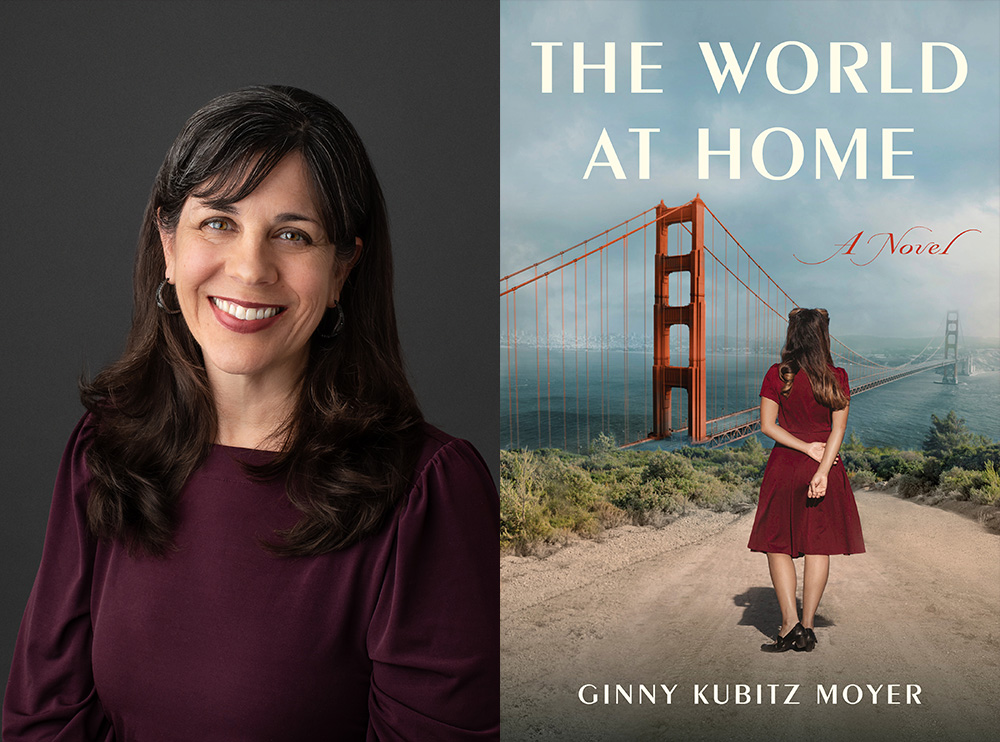
We chat with author Ginny Kubitz Moyer about The World At Home, which is a coming-of-age story about a young woman discovering love, loss, and the power of her own creativity in World War II San Francisco.
Your book is set in San Francisco during WWII. There aren’t many books about this city then (or any?) Why is it important to fill this gap?
WWII is well-represented in fiction, but there have been surprisingly few novels written about the American home front during that time. Since I’ve always been interested in women’s lives and history, this was a subject that fascinated me. How did women at home navigate the uncertainty of living in a time of war? How did they handle rationing, sending loved ones off to war, waiting nervously for news from overseas? What were the coping strategies that kept them going? As an author and reader, I was curious about all of that.
And San Francisco played a critical role in WWII. Poised on the edge of the continent, the city ended up being the embarkation point for 1.6 million troops. During the war the city was flooded with servicemen, often enjoying one last bit of freedom before shipping out to a war from which they knew they might not return. That gave San Francisco a unique energy and changed the social dynamics of the city for the young women who lived there.
All of your main characters are strong young women on the cusp of adulthood, or just into adulthood. What interests you about this stage of life?
I’m always fascinated by how people make big life choices and why they choose what they choose. When you’re a young adult, you are generally engaging in big life decisions for the first time. You are identifying who you are at your core and what you want your life to be, grappling with basic questions of identity and purpose. Although you return to those questions throughout life, there’s a certain intensity to that first experience of them. I think that’s why coming-of-age stories are so enduringly popular … we can all relate.
Irene is a seamstress and designer who developed her interest through playing with paper dolls in childhood. What led you to a second career as a novelist?
To me, there’s nothing better than reading a truly immersive novel. But I never thought I’d ever write one, because I didn’t know how to come up with a plot. I had no idea how to just conjure up an outline out of thin air.
But in 2016, the idea of writing a novel felt very urgent and wouldn’t let me go. Finally I gave in and started writing scenes based on some characters I had vaguely in mind, set in a place I loved (the San Francisco Peninsula) in 1910. And I found that you actually don’t have to know your plot in advance. You can just take it one scene at a time and let the characters reveal themselves to you and figure out the plot as it unfolds. It was an absolutely thrilling discovery, and the end result was my first novel, The Seeing Garden.
For several years, I was writing fiction while also teaching high school. But in 2023, after a lot of discernment, I made the decision to step away from teaching and focus solely on writing. It was a big adjustment to go from having a very social daily routine to such a solitary one, but it was the right decision for this point of my life. And the through line connecting both careers is a love of story. For the 26 years that I was teaching, I got to see how stories inspired and challenged and comforted other people. Now I’m still working with stories … but writing them instead of teaching them.
What research did you have to do for this novel?
One subplot of the novel is that Irene, my protagonist, helps make costumes for the San Francisco Ballet’s production of The Nutcracker. (That 1944 production was actually the first time the entire ballet had ever been performed anywhere in the U.S., a fact that surprises lots of people and certainly surprised me.) Early on in my writing of the novel, I spent an afternoon at the SF Ballet archives, going through the files of the young man who designed the costumes in the fall of 1944. There’s something very moving about that first production, when wartime rationing was in full force and they were literally cutting up curtains to make costumes. I think it’s a real testament to the power of art to give us life during difficult times.
I did a lot of research into life in San Francisco in 1944, both from books and on the ground. My favorite bit of research was going to the rooftop bar The Top of the Mark, which was a popular hangout for servicemen in WWII and where two scenes of the book are set. When you sit there at a small table, looking down at the rooftops of the city and seeing the evening fog creep in over the Golden Gate, it’s one of those magical experiences you just don’t forget.
What’s next for you?
I’m currently finishing a novel set in the 1950s. It’s a comedy of manners about five sisters living in a rambling house built by their famous grandfather. I’ve grown very fond of the sisters, and I hope readers will love them too.
Will you be picking up The World At Home? Tell us in the comments below!
Source link


