Indies Introduce Q&A with Laura Venita Green

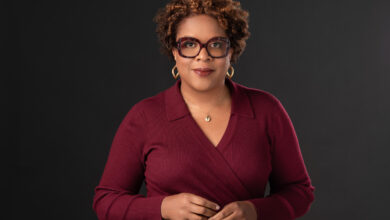
Laura Venita Green is the author of Sister Creatures, a Summer/Fall 2025 Indies Introduce selection.
Laurie Gillman of East City Books in Washington, DC, served on the panel that selected Green’s book for Indies Introduce.
“I was blown away by Laura Venita Green’s debut novel, Sister Creatures,” Gillman said. “The stories of four women, loosely connected by their small Louisiana town, connect, break, and re-connect through their lives and experiences. These indelible characters are driven by their desire for something more, more than the lives they find themselves in. The Gothic undertones of the novel — fairy tale references, weirdly threatening triplets, dark woods where dark things happen — shift the perspective from mundane to something strange and magical as these very human stories play out. A must-read!”
Green sat down with Gillman to discuss her debut title. This is a transcript of their discussion. You can listen to the interview on the ABA podcast, BookED.
Laurie Gillman: Hello, my name is Laurie Gilman. I am from East City Books in Washington, DC, in the Capitol Hill neighborhood, and I’m interviewing an Indies Introduce author today, Laura Venita Green.
Laura Venita Green is a writer and translator with an MFA from Columbia University, where she was an undergraduate teaching fellow. Her fiction won the Story Foundation Prize and appears in Story, Joyland, The Missouri Review, and Fatal Flaw. Raised in rural Louisiana, Laura now lives with her husband in New York City. Sister Creatures is her first novel.
Before we get started with our conversation, I just want to say that the process of choosing books for the Indies Introduced panel goes on for a few months, and obviously you read a whole lot, and I was reading your book in manuscript form during the last week of the process. I will admit — there can never be too much to read — but there is a point where you’re like, “Okay, now I’m just getting through all these. I’m going, going, going.”
When I got to Sister Creatures, I was kind of in that mode, and then I just thought, “Oh, wait a second, this is the book I’ve been wanting to read. This is grabbing me.” I felt like I slipped into a different mode, and it really stuck with me. I’ve been talking about it since then, and wanted to do this interview. That’s the kind of book it is. We don’t want to do spoilers and things, but if there are booksellers listening, you really should read it.
It’s a novel that is interconnected stories, of characters who have different but connected stories. Was there one character that came to you first that really inspired the rest of the characters? Or was it all these people trying to get out? How did it come about?
Laura Venita Green: Oh thanks so much, Laurie! I’ve really been looking forward to this conversation with you.
The protagonist who starts out the book is Tess, and it took finding her and her voice for me to feel that this could be a book-length project, but she wasn’t the first one that showed up. I have these four women from the same small town in Louisiana and this supernatural entity that looms over their lives, so that’s five characters. I had an individual point or a story for each one of those characters; Gail living in New York City, Olivia falling for her older coworker, Lainey struggling with her little sister. Then the shapeshifter in the woods in Louisiana who could never be satisfied with what she already had.
Tess showed up last, and once I had her, she was actually about to move with her family to Germany. When I found her, once I had her voice, her attitude, her judgment on the world, her sense of humor, and just her flaws and her humanity, I felt that I could make a whole book out of this. Then it was just my job to understand how these people are related. What does their story look like? Because I know it’s connected, I just don’t know how yet.
LG: Oh, fascinating! I have to say that Tess is the glue.
I also grew up in a small town in west Texas, and it was spot-on for her attitude, her outlook, her struggles. I loved her and every choice she made, good or bad, she was a wonderful character. It’s fascinating that she was about to move to Germany. How did that early part of her life get filled in?
LVG: Tess is great. Sometimes you want to shake her, and I do think the novel is helped by looking away from her at times so you don’t get overly frustrated with her. Once I had these characters, and I knew they were related, and Tess, even though we started when she was moving to Germany, was always from this place in Louisiana. Only the first third of the book takes place in Louisiana, but all of these characters are informed by having come from this place. So even when I wrote her later in life, not living there, she was from there.
So I thought, “Okay, I’m gonna put Tess, Gail, and Thea here.” Thea is this entity who shows up as many forms throughout the book, and starts out in the form of a creepy doll. I just put them in the same room and let them do their thing. I had no plan for it. Then once you do that, you find out the beginning of the book, which I wrote about halfway through the writing process, then you can go back to their later life points, because you have a lot more information. Then it’s this reiterative process of learning more and going back and forth.
LG: It really did work well. Following up on that idea of this town — and I know people always want to ask, “Is this autobiographical?” — but I do tend to ask, because as a fellow small-town person I feel like that does give you a very particular lens on the world, and maybe especially in the southern part of the US. Do you think that’s true and do you think that your own history has anything to do with the way the book turns out?
LVG: Yeah! So I was an army brat growing up who lived in Germany for my six of my first eight years of life, but then from age eight to eighteen, I ended up in rural Louisiana, in this town of about 1,200 people, in a very conservative Bible Belt area where everyone knows everyone else’s business and everyone’s just as intelligent as anywhere else but there aren’t necessarily a lot of opportunities for cultural education.
Even when these characters are not there, they are just so affected by this place they came from. There’s this sense that home shapes you so much, and then once you leave, you really can’t return. Even if you physically go back, there’s no way to really return.
It’s interesting because after moving from Louisiana, I lived in Austin for 18 years, and I’ve lived now in New York City since 2019, and my imagination always goes back to rural Louisiana where I grew up. It was also very helpful to touch that setting through a few different character’s lenses.
For instance, you’ve got Tess at the beginning already feeling at age 20 that her life is imploded. Luckily it hasn’t, she has a journey from there, but that’s how she feels. She senses the humidity, the oppressiveness, the bugs swarming around the trees that got felled in this backyard where she is. On the other hand, you have Lainey, who loves the place and has all her fond memories from there, she appreciates the beauty and has an ability to live in nature. Then you have Olivia, who is this ambitious high school senior already on her way out, and she’s just dismissive.
LG: Yes, yes. I was thinking about that character, because there certainly is plenty of this in small towns waiting to get out, and then that feeling that it’s really hard to find a way to leave, if that’s what you want. I appreciate that.
I was also curious about how your training as a translator affected, not just the characters, but the way you structure things and the way you think about things?
LVG: It has had such an effect! I was writing a lot of this book when I was in my MFA program at Columbia, and at Columbia, if you take fifteen of your sixty credit hours in translation, you can have a dual degree in fiction and translation. So I was reading widely in translation, and practicing translating from Italian, which is not a language I know well. I decided to start teaching myself, because I didn’t want to be someone who only knew one language their entire lives.
LG: I wondered about that!
LVG: Yes, that has affected this book so much. On one hand, it’s just understanding that there are infinite ways to tell the same story. In translation work, you’re reading so many books and you’re seeing all these non-obvious — or not obvious to the American reader — ways to tell stories. It makes you slow down and think about your sentence level work.
That’s not naturally what my mode is. As a writer, I’m so invested in the characters and the action that’s taking place, that only after the fact can I think, “Okay, how can I actually structure this sentence? What’s the word choice here?” So that’s the obvious way it has affected this book.
But beyond that, I’m sort of obsessed with translation and Italian, and the fact that I don’t still know how to speak it, even though I’ve been studying for about seven years. I did give that experience to Tess with German. She meets someone very early on, Gail, who speaks German and writes her this German note. It kicks off this love of German and this interest in it. I think she similarly feels sheepish about the fact that she can’t quite get there with the language, but she’s always studying it.
LG: Yes, I can identify with that as well. I’m sure there are others out there.
I read it, as I said, as a bound manuscript. In looking at reviews and things coming out there, people always mention that the book is interconnected stories, and my experience of it felt really different than that. I get it, but I just felt like I was reading a novel. The format, of course, makes a difference. Did you picture it being structured as interconnected stories from the beginning?
LVG: I took about four years to write this book, and then another two years to get it out into the world. When I was querying, I actually queried it as a novel in 13 stories. I have such a pattern making sort of brain, so as I mentioned, I had these five individual stories, and then I started creating the book around that.
I also just had to let it happen from there. I didn’t have a plan. I did originally think that it was a novel in stories, and I think it is, but there’s this spectrum of story collection to novels that ranges from completely unconnected to a traditional chronologic sweeping arc for one character. This book falls just on the novel side of that, at least for me. It’s the type of book where, if a reader comes into it ready to participate, I think it does read more as a novel. It’s that type of book where you get to a point and then you have to flip back a few chapters and say, “Oh, I’ve already seen that, that has new meaning now. Oh, I didn’t realize that was going to be important.”
It’s just one of those books that you need to participate in to get the full effect of it. My editor at Unnamed Press, Chris Heiser, who has been great, really did help me shape more towards a novel, getting rid of some of the extra characters and making sure the connections that I already had in there were unburied a little bit. It was a whole process, but I really do think at this point that this book is a novel.
LG: Yeah, that’s interesting. That is definitely how I experienced it. For marketing purposes as booksellers, we have to categorize things so we can tell people in very brief language what to expect.
Do you have a favorite character, or one that felt like your guiding light? Were there any that were particularly inspired by a myth or a folktale or anything like that?
LVG: This book does come across as inspired by folktales or by myths. Really, I just start with a character, let odd or strange things happen, and then figure out my best way to make it fit in the book. Some of the more dramatic characters are Gail and Thea. Thea is this entity, but Gail was just living in New York City, and I just had her meet her doppelganger and have a very odd conversation with her doppelganger. That is what informed her entire story.
I had no plan. I just learned a lot about her from that odd conversation, and then let her story be what it was, and it was my job to make it work in a book. So that’s how Gail got kicked off. With Thea, same situation. I wanted the shapeshifter in the woods to work in this book, and I thought, “How can I do that?” I do think the reader really needs to decide how they want to read Thea. Initially I thought, “Okay, Tess is going to meet this character, Thea, and then imagine these scenarios for her.” But, of course, anytime you create a character, she becomes way bigger than you ever planned. And that was certainly what happened in Tess’ case as well. But none of these characters were based off of anything in particular, other than just allowing myself to get strange with it.
LG: I love that, because it is this world that is interconnected by a feeling of folktale and mythology and things happening out there that you can’t really see, which a lot of that is due to Thea. I was enjoying reading Thea as this interconnective tissue of what all these women want. It made it feel like the story went way back and way forward to me, so I really enjoyed that. I just kept thinking, “This must have been really hard to do.”
LVG: Part of it was not holding too much control. The hardest part was Thea wanting to be so much more than my plan for this book, and somehow, I needed to allow that to happen.
LG: How do you do that? Do you just have to spend a lot of time wrestling with this character?
LVG: It’s a lot of time, a lot of revision. A lot of — and I think this plays out a bit in the book — this butting heads between Tess and Thea, because Thea is not cooperating with her. That’s how I feel for really any character I write, like, “Oh, you, I have this plan for you. You are not following this plan.” Ultimately, I always lose that battle. But in these early drafts, I felt that battle every single time.
LG: That’s fascinating. I’m just sitting here thinking, “Wow, that sounds like being a parent!” Lots of similarities there!
LVG Yeah, a lot of mother-daughter dynamics came through, especially in the last third of this book, and I absolutely made that connection having this character. Having this book really does feel like having a child out in the world to me, which is hilarious but it’s true.
LG: I would imagine you feel a little protective and a little worried.
I really hope that everybody listening will read this book, and I’m going to move a little bit away from the story and the creating of it to the experience that you had as a debut novelist.
As booksellers, we do spend a lot of time doing our own marketing, but we also spend time talking about the world of publishing, how books are marketed, and how that’s going to affect what we sell, or what we purchase for our inventory, and how we’re going to approach selling it.
You’ve gotten lots of great reviews, this book is an Indie Next List selection and an Indies Introduce pick. What was your experience like and do you have particular advice for other debut novelists?
LVG: Publishing is pretty opaque; even debut novelists who work in publishing don’t seem to feel that they are more in the know. There’s just this sense of having to jump in, say yes, and learn as you go. I was so excited to get a book deal, but the first few months I was living in the state of anxiety because I’m someone who likes to know as much as possible when I dive into something and that wasn’t going to happen. I was only going to be able to learn as I go.
The biggest thing to me is finding community. I applied to the Poets & Writers Get the Word Out publicity incubator, and got to work with nine other debut authors and a publicity mentor. We’re still in touch. It was a twelve-week, weekly program, and we learned a lot, but also, we have each other’s backs for our debuts. It’s really supportive.
Same with my small press, which has three debuts coming out in the fall. We’re about to have an event at Books Are Magic together, so we’re working with each other.
It’s imperative to find other debut authors, and to support other books and events all year. It’s easy for me in New York City, there are so many choices. I’ve been to a couple of events a week all year long. But really, even if your option is online events, attend those and then follow up with the author. They are always happy to hear from you. I’ve been meeting authors all year and supporting books, which means that they are now supporting my book and it’s paying off. Just think of publicity as the opportunity to tell people about the art you made; it is not going to land in front of them if you are not helping it along the way.
Finally, this Indies Introduce program has been huge. Right now, I’m seeing my book in all of these bookstores and that is just the dream. It is a dream come true. I’ve also been into my local bookstores, just trying to develop relationships with booksellers. My local West Village bookstore, Three Lives & Company, now has my book, but when I was writing reading lists for these publications, I’d go in and say, “What are your thoughts about books on this theme?” So, building those relationships throughout the year is my biggest piece of advice.
LG: Oh, I love that. So you would say — just because I have a feeling people are hesitant — reach out to the author. Just go for broke, reach out to people. The worst someone can do is say is, “I don’t really have time to do this right now.”
LVG Absolutely, and it’s true. So much of this writing life is rejection, and some of the people you reach out to will not be receptive, but the vast majority are. Everyone wants to know that you have a book coming out, or what your writing journey is. So absolutely reach out and if you don’t hear back, move on.
LG: That’s great advice. Support from your community is always something we’re talking about at the bookstore, and it seems like that’s the case for authors also. There are writing groups, there are so many ways that authors connect, and so it makes sense that as you’re going through this part of the process that you would also need ways to connect and form community.
Thank you for that advice, and I want to thank you again, Laura, for being here. It was so wonderful talking to you. I’m thrilled that I got to speak with you.
Laura Venita Green, the novel is Sister Creatures, and it is available at your local independent bookstores.
LVG: Thanks so much, Laurie!
LG: Thank you, Laura.
Sister Creatures by Laura Venita Green (Unnamed Press, 9781961884571, Hardcover, Fiction, $28, On Sale: 10/7/2025)
You can learn more about this author at lauravenitagreen.com.
ABA member stores are invited to use this interview or any others in our series of Q&As with Indies Introduce debut authors in newsletters and social media and in online and in-store promotions. Please let us know if you do.
Source link